
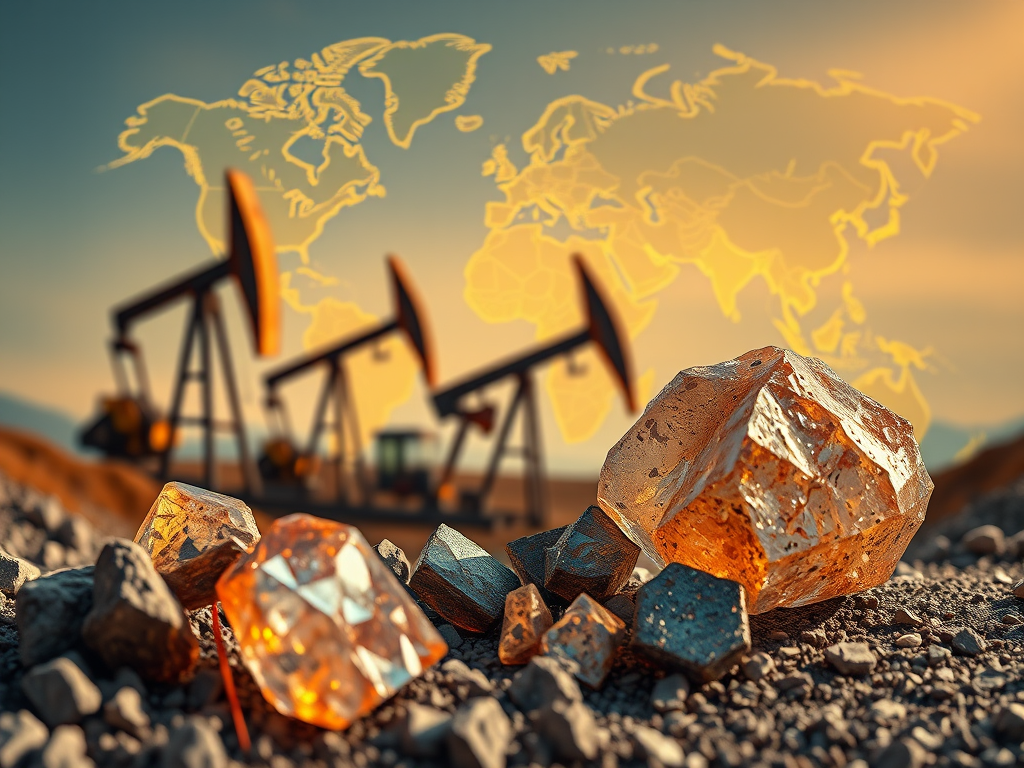
For much of the past three decades, globalization promised cheaper goods, efficient supply chains, and rising productivity. That promise was built on the assumption that raw materials and components would flow smoothly across borders. Today, that assumption seems to be breaking down. Critical minerals such as lithium, rare earth elements, graphite, gallium, and nickel have become strategic choke points for the global economy. They are essential for clean energy and consumer electronics, along with semiconductors, artificial intelligence, and modern weapons systems. As a result, they are now reshaping both geopolitics and economic power.
China’s dominance in processing many of these minerals has turned supply chains into a strategic vulnerability for the United States and its allies. What used to be a technical supply chain issue is now a macroeconomic struggle, and when supply is disrupted, entire industries face higher costs, production delays, and lost competitiveness.
A recent U.S. Geological Survey study puts numbers on this risk. After modelling more than 1,200 disruption scenarios, it found that supply shocks in key minerals could cause billions of dollars in losses to U.S. GDP. These losses would show up as higher prices, lower output, and weaker growth across multiple industries. In practical terms, mineral insecurity can mean more expensive vehicles, as shortages will cause significant price spikes that also increase costs for manufacturers of electric vehicles, renewable energy, and consumer electronics.
Critical minerals are no longer just a trade or environmental issue, but a core economic security issue. If access to key inputs is unreliable, firms delay investment, governments face higher fiscal costs, and economies become more exposed to inflationary shocks.
In response, Washington has begun to treat mineral supply chains as strategic infrastructure. Policies now include subsidies for domestic mining, strategic stockpiles, and partnerships with allies. There are even discussions of creating a price floor system for critical minerals to stabilize markets and encourage private investment. In economic terms, mining and processing projects are capital-intensive and risky, and volatile prices can scare off investors. A price floor could reduce uncertainty, support long-term planning, and help build non-Chinese supply chains. In the short run, this may raise costs for consumers and firms, but in the long run it could lower the risk of severe supply shocks and protect industrial capacity.
Still, strategy remains inconsistent. A Bloomberg analysis argues that while the U.S. wants to reduce dependence on China, it has undermined its own goals by allowing advanced technologies and research ties to continue. This contradiction has real economic consequences. Technological leadership is a key driver of productivity, high-wage jobs, and long-term growth. If strategic rivals gain access to cutting-edge research, the U.S. risks eroding its own competitive edge.
Other countries also seem to be moving in the same direction. Canada, for example, is now linking critical minerals to its defence and industrial strategy, using government procurement to support domestic production and strengthen supply chains. This reflects a broader shift toward industrial policy aimed not only at security, but also at jobs, investment, and competitiveness.
Critical minerals sit at the foundation of modern growth. This resource war is not just U.S. vs. China. Middle powers and the Global South are reorganizing themselves around these supply chains too. Brazil and India are now discussing cooperation on critical minerals, with both countries wanting to move into processing and onto higher-value stages of the supply chain. Countries that only export raw minerals tend to stay stuck with low margins and volatile revenues, while countries controlling the processing get better jobs, more stable investment, and more geopolitical leverage. The fight over critical minerals is, in the end, a fight over who controls the future of growth.
References
Brands, Hal. Four Fatal Problems in the New US Approach to China. Bloomberg Opinion, February 6, 2026.
U.S. Geological Survey (USGS). Methodology and Technical Input for the 2025 U.S. List of Critical Minerals — Assessing the Potential Effects of Mineral Commodity Supply Chain Disruptions on the U.S. Economy. Open-File Report 2025–1047, 2025.
Bloomberg News. US Funded $1 Billion in Research With Chinese Labs, Report Says. February 19, 2026.
Bloomberg News. US Agencies Have Developed Critical Minerals Price Floor System. February 17, 2026.
Mining Weekly. Canada’s Defence Strategy Opens Door for Critical Minerals Resource Growth. February 19, 2026.
Bloomberg News. Brazil and India Set to Strengthen Cooperation on Critical Minerals and AI. February 2026.



Leave a Reply